.svg)




Stress and glucose levels
⏱ 2 minutes read
Did you know that stress can raise your glucose levels? Find out how you can reduce stress to improve your glucose control.
Get quick and easy access to our support team.
ADC-109888 v1.0






GB Mainland: 3 day delivery
Northern Ireland: 3-4 day delivery
(Estimated standard delivery)

All payments are secure and encrypted

Your cart is empty
Learn about the importance of physical activity and emotional wellbeing and their impact on your sugar
levels and diabetes management.

 |
As most of us know, exercise is good for our health, benefiting our hearts, bodies and minds. It has been shown to help prevent conditions such as cardiovascular disease, cancer and diabetes and reduce symptoms of depression and anxiety, enhance brain health, and improve overall wellbeing.1
Physical activity helps to lower glucose levels because our muscles need to use more of it as we work out.2
If you're living with diabetes then physical activity is all the more valuable. As well as lowering your glucose levels, it can also help with:

The World Health Organization recommends that adults should do at least the following every week:
However, every little helps. You don’t have to run a marathon – anything that gets you moving is worthwhile, and the more you enjoy it, the more likely you are to keep it up.
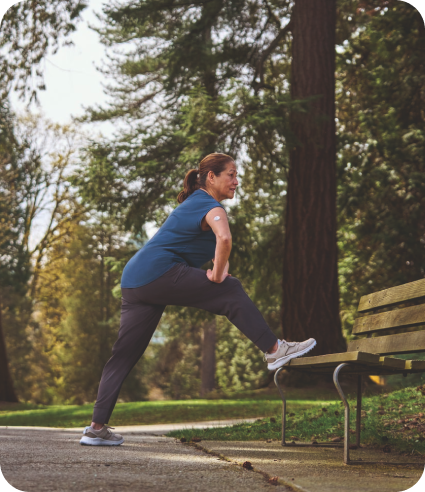
If you can talk but would struggle to find the breath to sing, it's moderate intensity.
If you can't keep up a conversation while exercising, it's vigorous intensity.
Physical activity is any form of movement that causes your body to burn calories, like cleaning, gardening and using the stairs.
Take the stairs instead of the lift or park your car a little further away from your destination.
A brisk 20-minute walk each day could be enough to reduce your risk of early death.7
Yoga can be used to tackle stress and anxiety.8 You can either find a local class or stream one into your home at a time to suit you.
Try doing some seated chair exercises. Chest stretches, upper-body twists, ankle flexes, arm raises, and more, are all perfectly possible from a seated position – and all thoroughly worthwhile!
Swimming provides a great full-body, low-impact work out – ideal for people with stiff joints, aches or pains.
As we know, living with diabetes can be challenging. Looking after your emotional wellbeing is just as important as physical health.
There will be good days and difficult days; times when you feel you’ve got this, and times when everything feels a little overwhelming. That’s not just perfectly understandable, it’s also very common, but by learning some simple strategies you can help insulate yourself from potentially damaging thought patterns.
People who are living with diabetes are more prone to depression. Even if you’re not clinically depressed, negative thinking can stop you from managing your health properly.
E.g. I'm a failure, I haven't been running for three days.
Why haven't you been running - are there mitigating circumstances? Did you run other days this week? Have you done any other physical activity?
I've had a lot on at work but still managed to go running four days this week and I walked home with the groceries instead of catching the bus.
⏱ 2 minutes read
Did you know that stress can raise your glucose levels? Find out how you can reduce stress to improve your glucose control.

⏱ 6 minutes read
Get familiar with the tools and the resources at your disposal to support your diabetes care with confidence.
The “Yes” link below will take you to a website other than Abbott Laboratories. Links pointing you to other websites are not under the control of Abbott Laboratories, and Abbott Laboratories is not responsible for the content of such websites or other links contained on such website. Abbott Laboratories provides these links only as a courtesy and the inclusion of any link does not imply endorsement by Abbott Laboratories of the site.
Do you want to leave this page?
FreeStyle.abbott/uk-en is a product specific website only intended for residents of the United Kingdom. If you live in another country, please contact your local Abbott office to obtain the correct product information for your country of residence.

