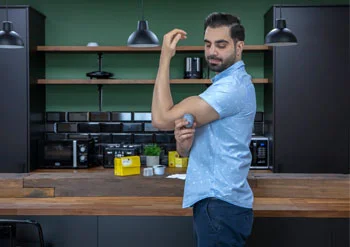

Waking up.
Your body naturally releases glucose in the early morning hours to help you wake up632. Check your overnight patterns for a full picture of your glucose.
Current glucose reading
Minute-by-minute glucose reading, displayed in a colored banner to let you know if you're in range100.
Trend arrow
The direction your glucose is heading and how quickly it's rising or falling.
Glucose history
Choose your time range to view your glucose data history over the last 3, 6, or 12 hours.
Add note
Logbook to track carbs, insulin use, physical activity, and other events.
Glucose Alarms18 let you know if your glucose reading has gone above or below your set threshold.
Know where your glucose is headed.
The arrows indicate the direction of your glucose readings30,31,53, helping you interpret them more easily, and to respond as needed.
Arrow up: Glucose is rising quickly, more than 2 mg/dL (0.1 mmol/L) per minute
Arrow up and right: Glucose is rising slowly
Arrow right: Glucose is steady or changing slowly
Arrow down and right: Glucose is falling
Arrow down: Glucose is falling quickly, more than 2 mg/ dL (0.1 mmol/L) per minute
Sugar enters the blood first, which is what finger pricks measure32.
Then, it enters the interstitial fluid (ISF) found around cells beneath the skin – this is what sensors measure32. Both are accurate but at slightly different points in time.
Think of blood sugar as the engine of a train,
and the interstitial fluid or sensor sugar as the trail car32.
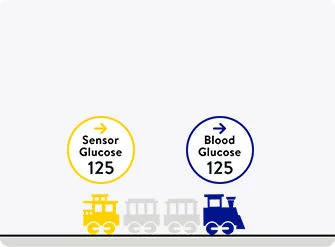
When sugar levels are stable, there’s little difference in measurements.
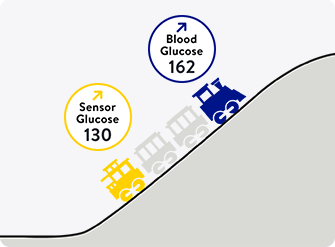
As sugar levels rise, like they can after a meal, sensor sugar lags behind blood sugar32.
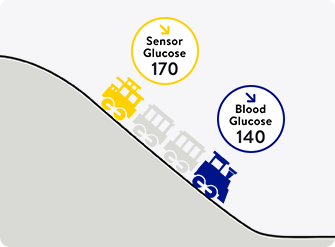
After medication or exercise, sugar levels may fall with sensor sugar again lagging behind32.


Clicking the "Yes" link below will take you to a website other than Abbott Laboratories. Links that direct you to other sites are not under the control of Abbott Laboratories. Abbott Laboratories is therefore not responsible for the content of such websites or for any other links that may appear on this website. Abbott Laboratories provides these links only as a courtesy, and the inclusion of a link does not imply approval of Abbott Laboratories for this page.
Leaving Page?