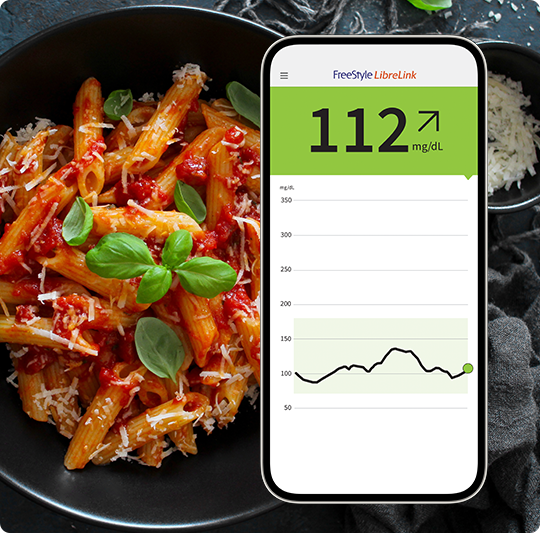


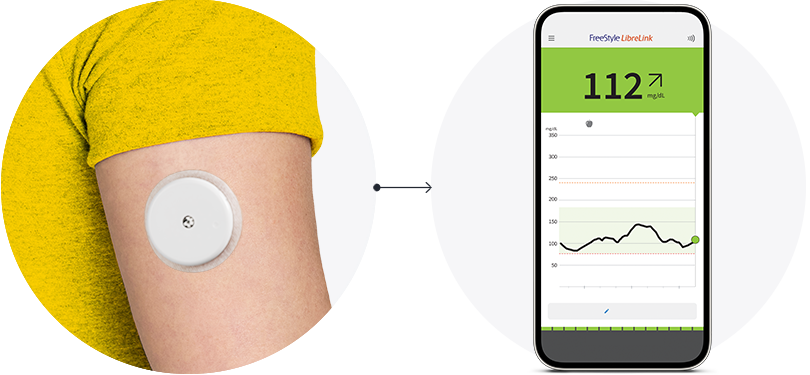
Use the data on your FreeStyle LibreLink app12 to see how you’re progressing over time.
- Real-time sugar information
- Time In Range
- Trend Arrows
Monitor trends and patterns from your device to see how well you’ve been managing your sugar over time.
-
Current sugar reading
Measured every minute, and the color lets you know if you’re in range.
-
Trend arrow
Indicates the direction your sugar is heading and how quickly it’s rising or falling.
-
Sugar history
Continuous sugar graph shows how your levels have changed.
-
Add note
Track food, insulin use, exercise, and other events.
Track your progress over time to see how much time you’ve spent in or out of range.
-
Target Glucose Range
The more time you spend here, the better your A1c.
-
Above Target Glucose Range
Shows when your sugar was too high so you can pinpoint what may have caused it to spike.
-
Below Target Glucose Range
Shows when your sugar was too low so you can pinpoint what may have caused it to dip.
You may not always be within your target range, but knowing what it is can help you better understand how food, activities, and medications can impact your sugar.
Know where your sugar is headed.
The arrows indicate the direction of your sugar readings, helping you interpret them more easily, and to respond as needed.
Monitor trends and patterns from your device to see how well you’ve been managing your sugar over time.
-
Current sugar reading
Measured every minute, and the color lets you know if you’re in range.
-
Trend arrow
Indicates the direction your sugar is heading and how quickly it’s rising or falling.
-
Sugar history
Continuous sugar graph shows how your levels have changed.
-
Add note
Track food, insulin use, exercise, and other events.
Track your progress over time to see how much time you’ve spent in or out of range.
-
Target Glucose Range
The more time you spend here, the better your A1c.
-
Above Target Glucose Range
Shows when your sugar was too high so you can pinpoint what may have caused it to spike.
-
Below Target Glucose Range
Shows when your sugar was too low so you can pinpoint what may have caused it to dip.
You may not always be within your target range, but knowing what it is can help you better understand how food, activities, and medications can impact your sugar.
Know where your sugar is headed.
The arrows indicate the direction of your sugar readings, helping you interpret them more easily, and to respond as needed.
Why don’t blood sugar
and sensor sugar readings match?
Sugar enters the blood first, which is what finger pricks measure32.
Then, it enters the interstitial fluid (ISF) found around cells beneath the skin – this is what sensors measure32. Both are accurate but at slightly different points in time.
Think of blood sugar as the engine of a train,
and the interstitial fluid or sensor sugar as the trail car32.
When sugar levels are stable, there’s little difference in measurements.
As sugar levels rise, like they can after a meal, sensor sugar lags behind blood sugar32.
After medication or exercise, sugar levels may fall with sensor sugar again lagging behind32.
Stay up to date with the latest information