

Category: Food and Nutrition
The balanced plate: Building diabetes-friendly meals1

Food nourishes more than just your body—it’s woven into your daily routine, traditions, and shared moments.
So when you're diagnosed with diabetes, it can feel like everything about food has to change. Suddenly, every meal becomes a question: What should I eat? Will this spike my glucose? Am I getting it right?
Understanding how food impacts your body can feel overwhelming. One of the easiest ways to start? Learn how to balance your plate.
This approach can help you keep glucose levels more stable—without complicated counting1.
Discover how balanced eating impacts your glucose levels with FreeStyle Libre systems, a continuous glucose monitoring (CGM) system2. Make informed choices and see the difference even small changes can make2.

How does food affect glucose levels?
Every time you eat, your body breaks down food into nutrients that provide energy. One of these nutrients is glucose, which enters your bloodstream and is used by your cells. But if you have diabetes, your body struggles to use glucose effectively4.
Different foods impact glucose in different ways, and your Libre systems data can help you see how your body responds to what you eat4.
How each food group affects glucose levels:
Food sequencing isn’t just about time in range. It offers a few potential benefits for managing diabetes.

Carbohydrates
Carbohydrates like starches and sugars have the most direct and immediate impact on glucose. These break down and are absorbed quickly, leading to spikes in glucose levels5.

Fiber
Fiber is a different type of carbohydrate—one your body doesn’t digest or absorb. Instead, fiber slows down digestion and regulates how glucose enters your bloodstream6.

Proteins
Proteins have little immediate effect on glucose unless eaten in large amounts. Proteins manage hunger and slow digestion, which can prevent glucose spikes7.

Fats
Fats can also help slow digestion, preventing glucose spikes. Unsaturated fats are important for your health but should be eaten in moderation. Saturated and trans fats (found in fried and processed foods) may contribute to higher A1C over time8.
Healthy eating isn’t always easy, but every small change adds up. Research suggests that balanced eating patterns can help reduce insulin resistance and may even slow the progression of type 2 diabetes9. You don’t have to get it perfect overnight—just start where you are, one meal at a time.

What is a balanced plate for diabetes?
The diabetes plate method is an easy way to build a balanced meal if counting carbs or calories feels too overwhelming. By structuring your plate with the right food groups, you can support steady glucose levels while still enjoying a variety of foods1.
A note of caution: Before you start, remember not to confuse the diabetes plate method with balanced plate approaches for people without diabetes. General nutrition models may emphasize whole grains and fruits in larger portions10. For people with diabetes, following those general recommendations could lead to glucose spikes. Consult with your healthcare team before making any changes in your diet.
Start with a small plate
Using a smaller plate of about 9 inches, rather than a large dinner plate, can help with portion control and prevent overeating1.
Fill half your plate with non-starchy vegetables.
Non-starchy vegetables are low in carbohydrates and calories while rich in fiber, making them ideal for filling half your plate1.
Examples of non-starchy vegetables include11:
- Leafy greens like spinach and kale
- Broccoli, cauliflower
- Bell peppers, zucchini
For the diabetes plate method, count starchy vegetables, such as potatoes, corn, and peas, as carbohydrates, not vegetables12.
Tip: Use frozen or pre-chopped vegetables to save time while cooking.


Add protein to a quarter of the plate.
Protein is important for building muscle and healing skin, and can even help with weight management. Yet many people with diabetes have trouble getting enough daily protein7.
Examples of healthy proteins include13:
- Lean meats like chicken, turkey, fish
- Plant-based proteins like tofu
- Eggs and low-fat dairy
Tip: Opt for grilled, baked, or roasted options instead of fried proteins.
Make carbs the last quarter of your plate.
Healthy carbs give you energy, fiber, and important nutrients. But keeping an eye on portion sizes is key, especially if you use insulin14.
Examples of healthy carbohydrates include5:
- Whole grains like quinoa, brown rice, and whole wheat bread
- Legumes like lentils, chickpeas, black beans
- Starchy vegetables like sweet potatoes or butternut squash
Tip: Try eating your carbs last, after your vegetables and proteins. This kind of food sequencing could help you avoid glucose spikes.


Use healthy fats in moderation
Healthy fats provide sustained energy and allow your body to absorb certain nutrients. However, they are calorie-dense, so moderation is key15.
Examples of healthy fats include15:
- Olive oil, avocados
- Nuts (almonds, peanuts) and seeds (chia, pumpkin)
Unhealthy fats, particularly saturated and trans fats, can contribute to insulin resistance and increase the risk of heart disease. These fats are commonly found in fried foods, processed snacks, and baked goods6.
Tip: To include healthy fats, drizzle olive oil on roasted vegetables or sprinkle nuts or seeds on salads or yogurt.
Choose a diabetes-friendly drink
Water is the optimal choice for hydration as it contains no calories or carbohydrates, ensuring it doesn't affect glucose levels. Staying well-hydrated supports overall health and helps maintain stable blood sugar16.
Other healthy drink options include17:
- Unsweetened tea
- Plain coffee
- Sparkling water
- Infused water
Tip: Avoid sugary drinks such as regular sodas, fruit juices, and energy drinks, as they can cause rapid increases in glucose levels17.

Building a balanced plate: Practical tips for every meal
Eating balanced meals doesn’t have to be complicated. Plan ahead to ensure you have ingredients ready to add to your plate.
- Batch cook proteins and grains to make meal assembly easier throughout the week.
- Use pre-chopped or frozen vegetables for quick, nutrient-rich additions11.

Breakfast
Half of the plate: Sauteed spinach, bell peppers, tomatoes, or mushrooms
Quarter of the plate: Eggs, cottage cheese, smoked salmon, or nut butter13
Quarter of the plate: Whole-grain toast or steel-cut or rolled oats, berries, or beans14
Tip: Add slices of avocado to savory breakfasts for a healthy fat source18.

Lunch
Half of the plate: Mixed green salad with cucumbers and carrots11
Quarter of the plate: Grilled or baked chicken or fish13
Quarter of the plate: Quinoa, whole-grain pasta, or farro14
Tip: Add homemade hummus for a healthy fat source19.

Dinner
Half of the plate: Roasted cauliflower, broccoli, or Brussels sprouts20
Quarter of the plate: Grilled or baked tofu or shrimp13
Quarter of the plate: Sweet potatoes, brown rice, or whole-wheat flatbread14
Tip: Flavor dishes with homemade sauces that don’t include sugar, such as a mix of olive oil and vinegar21.
What about combination foods?
Not every meal fits neatly into the diabetes plate method—and that’s okay. Dishes like casseroles, soups, sandwiches, pizza, and pasta combine different food groups, but you can still use the same balanced approach to keep your meal in check.
Think about the main ingredients—non-starchy vegetables, protein, and carbohydrates—and aim for the right proportions. Small tweaks can make a big difference.
Pizza: For healthy pizza22, opt for a thin, whole-grain crust, pile on vegetables like peppers and spinach, and choose lean protein like chicken or tofu. Pair with a side salad to keep half your meal vegetables.
Soup: For a balanced soup23, go for a broth-based version packed with vegetables and lean protein. Swap out white potatoes or noodles for whole grains like barley or quinoa.
With a few simple adjustments, you can enjoy your favorite dishes while keeping meals balanced.

Use Libre systems to learn how food affects your glucose levels.
Everyone’s body responds differently to food, and the best way to understand how meals impact your glucose is to see the data for yourself.
Libre systems can provide clear insights into how different food choices affect your time in range24. Try this simple experiment with Libre systems to see how a balanced plate with vegetables and protein may impact your glucose levels2,3,25.
Consult your care team.
First, talk with your doctor or dietitian about how to safely use Libre systems to track meals and glucose response.
Establish a baseline.
For a few days, eat your usual meals. Use Libre systems to monitor and record your glucose response for 1–3 hours after eating.
Try the diabetes plate method.
For the next few days, adjust your meals to follow the diabetes plate method as described in this article. Continue to track your glucose response with Libre systems after meals.
Compare results.
Look for differences in glucose spikes and trends between your baseline meals and the balanced plate meals.

Review with your care team.
Share Libre systems data with your doctor or dietitian. They can help you fine-tune your meals and make small changes that support better glucose management.
Using Libre systems to test and adjust can help you personalize your meals and make small changes that work for your body. Over time, you’ll get a clearer picture of how food affects you—helping you make choices that support more stable glucose levels2.
Progress starts with one balanced plate
Managing diabetes can feel overwhelming, but small, easy changes can make a real difference. The diabetes plate method helps you build meals that support steadier glucose levels—without complicated tracking or restrictions.
With Libre systems, you can see the impact of your food choices, making it easier to adjust and find what works best for you2.
You don’t have to change everything overnight. Start with one meal. One small shift. Over time, those choices can add up—to more stability, more confidence, and more control over your diabetes.

Choose the #1 prescribed CGM in the US*—FreeStyle Libre systems.
Learn more about Libre systems today.
CGM = continuous glucose monitor(ing)
More articles you may enjoy

Meal order matters—start in a glucose-friendly way.
What you eat first and last can affect your glucose.

Grab-and-go healthy snacks for busy days
Easy snack ideas can help you stay prepared with diabetes.

Simple ways to feel less stress with diabetes
Explore easy mindfulness exercises to help manage the stress of diabetes.
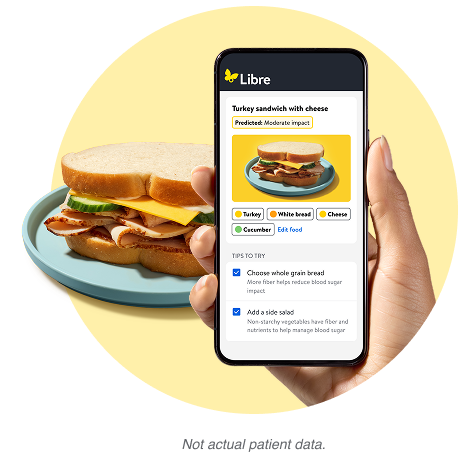
New! See your meal’s potential glucose impact† before you eat.
Progress is taking the mystery out of meals.
Try Libre Assist‡—available on the Libre app§.
The FreeStyle Libre 3 Plus sensor along with Libre Assist‡, predicts food impact on your glucose† and gives feedback after you eat.
Plus, your first sensor may be free♢! No credit card required, no strings attached.
Share this article:


FreeStyle Libre 3 system is cleared to be used by children 4 years and older with Libre 3 sensor and 2 years and older with Libre 3 Plus sensor.
FreeStyle Libre 2 system is cleared to be used by children 4 years and older with Libre 2 sensor and 2 years and older with Libre 2 Plus sensor.
Medicare and other payor criteria may apply.
* Based on retail and durable medical equipment sales data for patient’s last-filled prescription, by manufacturer.
† Predicted glucose impact is based on user-provided food data and may differ from actual impact, which depends on sensor readings and factors like activity, stress, medication, and alcohol. For personalized advice, consult your healthcare provider.
‡ Libre Assist is a feature within Libre app that uses generative artificial intelligence to provide information on how foods could impact your glucose levels. Generative artificial intelligence may not always be accurate, and it should not be used to make treatment decisions.
§ The FreeStyle Libre systems apps are only compatible with certain mobile devices and operating systems. Please check the Support section of our website for more information about device compatibility before using the apps. Use of the FreeStyle Libre systems apps may require registration with LibreView.
♢ Eligible patients will receive one (1) FreeStyle Libre 2 Plus sensor or (1) FreeStyle Libre 3 Plus sensor for users with a compatible mobile phone operating system at $0 copay. The expiration date of the voucher is 60 days from the issue date. This program is available for patients with Type 1 diabetes or Type 2 diabetes or gestational diabetes. Patients ages 18 and older are eligible to sign up and receive an offer for the (1) FreeStyle Libre 2 Plus sensor or (1) FreeStyle Libre 3 Plus sensor. Patients ages 2–17 are eligible to receive an offer for the (1) FreeStyle Libre 2 Plus sensor or (1) FreeStyle Libre 3 Plus sensor through their parent or guardian. This offer is void where prohibited by law. Abbott may modify or rescind this offer at any time without notice. The discounts are not available to beneficiaries of Kaiser Permanente, Medicare, Medicaid or other federal or state healthcare programs, residents of Massachusetts, or US territories (other than Puerto Rico). The free (1) FreeStyle Libre 2 Plus sensor or (1) FreeStyle Libre 3 Plus sensor is provided as a sample and is limited to one sample per eligible person per product identification number. The FreeStyle Libre 2 Plus sensor or FreeStyle Libre 3 Plus sensor cannot be re-sold, traded nor submitted to any third-party payer for reimbursement and is not provided as any inducement for future purchases. The free sample card is not health insurance.
References: 1. ADA Nutrition & Wellness Team. “What is the Diabetes Plate Method?” Diabetes Food Hub. American Diabetes Association, January 15, 2025. https://diabetesfoodhub.org/blog/what-diabetes-plate. 2. Merino, Jordi, et al. “Validity of Continuous Glucose Monitoring for Categorizing Glycemic Responses to Diet: Implications for Use in Personalized Nutrition.” American Journal of Clinical Nutrition 115, no. 6 (2022): 1569–1576. https://doi.org/10.1093/ajcn/nqac026. 3. American Diabetes Association. Good to Know: “Continuous Glucose Monitoring and Nutrition.” Clinical Diabetes 42, no. 3 (2024): 463. https://doi.org/10.2337/cd24-pe03. 4. National Institute of Diabetes and Digestive and Kidney Diseases. “What Is Diabetes?” April 1, 2023. https://www.niddk.nih.gov/health-information/diabetes/overview/what-is-diabetes. 5. American Diabetes Association. “Understanding Carbs.” Accessed December 21, 2025. https://diabetes.org/food-nutrition/understanding-carbs. 6. Mayo Clinic Staff. “Dietary Fiber: Essential for a Healthy Diet.” Mayo Clinic, November 7, 2025. https://www.mayoclinic.org/healthy-lifestyle/nutrition-and-healthy-eating/in-depth/fiber/art-20043983. 7. American Diabetes Association. “Let’s Talk About Protein for People with Diabetes.” February 24, 2025. https://diabetesfoodhub.org/blog/lets-talk-about-protein-people-diabetes. 8. Garonzi, Chiara, Gun Forsander, and Claudio Maffeis. “Impact of Fat Intake on Blood Glucose Control and Cardiovascular Risk Factors in Children and Adolescents with Type 1 Diabetes.” Nutrients 13, no. 8 (2021): 2625. https://doi.org/10.3390/nu13082625. 9. Shibib, Lina, et al. “Reversal and Remission of T2DM—An Update for Practitioners.” Vascular Health and Risk Management 18 (2022): 417–443. https://doi.org/10.2147/VHRM.S345810. 10. Harvard T.H. Chan School of Public Health. “Healthy Eating Plate.” January 1, 2023. https://nutritionsource.hsph.harvard.edu/healthy-eating-plate/. 11. American Diabetes Association. “Non-Starchy Vegetables for Glucose Control.” Accessed December 21, 2025. https://diabetes.org/food-nutrition/reading-food-labels/non-starchy-vegetables. 12. McKinney Christine. “The Truth About Starchy Vegetables.” The Johns Hopkins Diabetes Information. Accessed December 21, 2025. https://hopkinsdiabetesinfo.org/the-truth-about-starchy-vegetables/. 13. American Diabetes Association. “Protein Food for Diabetes.” Accessed December 21, 2025. https://diabetes.org/food-nutrition/reading-food-labels/protein. 14. Diabetes UK. “Carbohydrates and Diabetes: What You Need to Know.” Accessed December 21, 2025. https://www.diabetes.org.uk/living-with-diabetes/eating/carbohydrates-and-diabetes. 15. University of California, Davis. “Healthy Fats.” March 23, 2020. https://healthy.ucdavis.edu/eating-well/nourish-labels/healthy-fats. 16. Crowe, Amanda. “Why You Should Drink More Water.” American Diabetes Association. Accessed December 21, 2025. https://diabetes.org/food-nutrition/eating-healthy/why-drink-more-water. 17. ADA Nutrition & Wellness Team. “Best Beverages for People with Diabetes.” American Diabetes Association, May 20, 2025. https://diabetesfoodhub.org/blog/best-beverages-people-diabetes. 18. McKinnery, Christine. “10 Breakfasts to Help with Glycemic Control.” The Johns Hopkins Patient Guide to Diabetes. Accessed December 17, 2025. https://hopkinsdiabetesinfo.org/how-to-keep-your-grilled-food-healthy-2/. 19. Diabetes UK. “Make It Healthier: Hummus.” Diabetes UK. Accessed December 21, 2025. https://www.diabetes.org.uk/guide-to-diabetes/enjoy-food/eating-with-diabetes/healthy-swaps/make-it-healthier-hummus. 20. Newgent, Jackie. “Top 7 Veggies You Should Be Eating and Why.” American Diabetes Association, August 2, 2023. https://diabetesfoodhub.org/blog/top-7-veggies-you-should-be-eating-and-why. 21. Cleveland Clinic. "6 Major Benefits of Extra Virgin Olive Oil." January 16, 2024. https://health.clevelandclinic.org/benefits-of-olive-oil. 22. Cleveland Clinic. “Tips To Make Your Pizza Heart-Healthy.” October 5, 2022. https://health.clevelandclinic.org/how-to-make-healthy-pizza. 23. Diabetes UK. “Healthy Soup Recipes.” Accessed December 21, 2025. https://www.diabetes.org.uk/guide-to-diabetes/enjoy-food/cooking-for-people-with-diabetes/cooking-on-a-budget/super-soups. 24. Touhamy, Samir II, et al. “Carbohydrates-Last Food Order Improves Time in Range and Reduces Glycemic Variability.” Diabetes Care 48, no. 2 (2025): e15–e16. https://doi.org/10.2337/dc24-1956. 25. Willis, Holly J., Maren S. G. Henderson, Laura J. Zibley, and Meghan M. JaKa. “‘Now I Can See It Works!’ Perspectives on Using a Nutrition‑Focused Approach When Initiating Continuous Glucose Monitoring in People with Type 2 Diabetes: Qualitative Interview Study.” JMIR Diabetes 10, no. 1 (2025): e67636. https://doi.org/10.2196/67636.
ADC-119219 v1.0