


Breakfast
Step 1: Vegetables—a small serving of sliced cucumbers or tomatoes10
Step 2: Protein—a boiled egg or a handful of nuts7
Step 3: Carbs—a slice of whole-grain bread, a serving of oatmeal, or a small fruit.11
Category: Food and Nutrition
Category: Food and Nutrition

When you’re diagnosed with diabetes, you’re asked to make changes to how you eat—sometimes a lot of them. And that can feel overwhelming.
You try to eat more vegetables. You choose lean proteins. But despite your best efforts, your glucose levels still aren’t where you want them to be. That can be frustrating.
If you’ve ever felt this way, you’re not alone. Here’s an easy change that might help: food sequencing.
It’s a science-backed approach that might not require cutting out foods—just changing the order in which you eat them.
With food sequencing, some people see steadier glucose after meals1,2 And over time, this small shift may even lower A1C3.
Keep reading to learn:
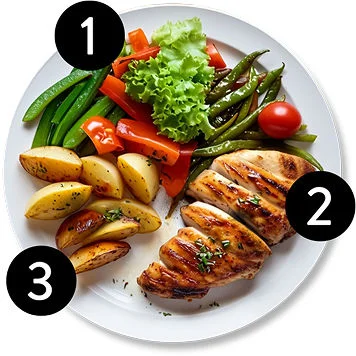
Imagine sitting down to lunch—potatoes, greens, and chicken. You’ve made a healthy choice, but what if a simple tweak could help keep your glucose steadier after eating?
Food sequencing follows this basic pattern1:
1. Start with vegetables.
2. Follow with protein.
3. Finish with carbs.
You might also hear food sequencing called the “vegetables first3” or “carbohydrates last4” method.
Nutrition is personal, and many factors impact glucose levels5. FreeStyle Libre systems make it possible for you to try this method out for yourself and see if it’s effective for you, using personalized glucose trends and patterns.
Food sequencing appears to slow digestion and control how quickly glucose enters your bloodstream, which may help prevent post-meal spikes1.
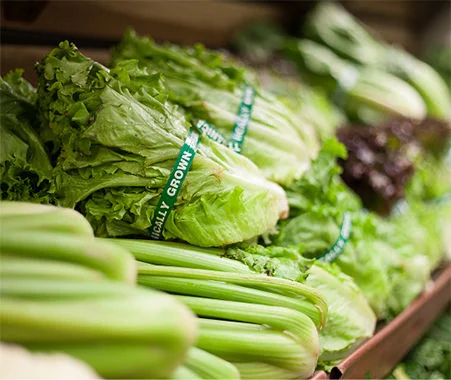
The fiber in vegetables slows digestion1.
Vegetables contain fiber, and eating fiber is a well-established tip for managing glucose levels1,6. The body doesn't absorb and break down fiber. In fact, soluble fiber creates a gel-like substance in the stomach that slows digestion—which can help control glucose levels6. Can you maximize its benefits? Potentially, yes—by eating it before carbs1.

Protein generates helpful hormones1.
A study found that eating just vegetables before carbs wasn’t as effective at lowering glucose levels—adding a protein source was essential2.
Similar to eating fiber, eating protein-rich foods like chicken, fish, eggs, and tofu7 before carbs helps slow down digestion. This gives your body more time to process glucose1.
Unlike fiber, protein triggers GLP-1, a natural hormone that helps regulate glucose and reduces appetite. GLP-1 keeps you feeling fuller longer and helps reduce cravings1.
GLP-1 = glucagon-like peptide-1

Healthy carbs are best saved for last.
As a food group, carbs have the biggest impact on glucose8. By saving carbs for last, you allow fiber and protein to act as a buffer, slowing digestion. Glucose enters the bloodstream more gradually, reducing post-meal spikes2.
Many people find it challenging to cut carbs completely. The good news is, you don’t have to9. Instead, try saving them for the end of your meal. Don’t forget to make easy swaps for healthy carbs, too.
Follow these quick tips to make food sequencing part of your daily meal planning.
Start every meal with vegetables.
Whether raw, cooked, or steamed, options like leafy greens, cucumbers, zucchini, or bell peppers are great choices10.
Incorporate a protein source.
Eggs, chicken, fish, tofu, or beans can help keep you feeling full and steady your glucose7.
Save (healthy) carbs for last.
Enjoy whole wheat bread, brown rice, whole grain pasta, or starchy vegetables like sweet potatoes after you’ve eaten your vegetables and protein11.
Season simply.
Use herbs, spices, or a drizzle of olive oil to add flavor without relying on heavy sauces, which often include sugar.
Balance your plate.
Try to make vegetables half of your meal and proteins and carbs each a quarter12.
A diabetes meal plan doesn’t have to be complicated. Small shifts like these can help you feel more in control13 of your meals and snacks while improving time in range14.
Step 1: Vegetables—a small serving of sliced cucumbers or tomatoes10
Step 2: Protein—a boiled egg or a handful of nuts7
Step 3: Carbs—a slice of whole-grain bread, a serving of oatmeal, or a small fruit.11

Step 1: Vegetables—a salad or a side of steamed vegetables like broccoli or carrots9
Step 2: Protein—grilled chicken, fish, or tofu7
Step 3: Carbs—a small portion of rice, quinoa, or lentils, or starchy vegetables like potatoes or sweet potatoes.11

Step 1: Vegetables—roasted or stir-fried vegetables such as eggplant, bell peppers, or green beans10
Step 2: Protein—grilled chicken, fish, or tofu7
Step 3: Carbs—a serving of brown rice, whole grain pasta, or plantains.11
Food sequencing can be an approachable way to manage glucose. But how do you know if it’s helping?
Libre systems help you make informed choices*15 so you can see the difference even small changes can make.

Consult your care team.
Before starting, discuss with your doctor or dietitian how to effectively use Libre systems to assess the impact of food sequencing.
Establish a baseline.
Spend a few days eating a normal dinner that includes vegetables, proteins, and carbs. Monitor and record how your glucose responds.
Try food sequencing.
For the next few days, try sequencing your dinner foods by eating vegetables first, followed by protein, and finishing with carbs. Continue to use Libre systems to see how your glucose responds.
Compare results.
Look for differences in your post-meal glucose spikes between baseline meals and sequenced meals.
Review with your care team.
Share your data with your doctor or dietitian to get additional feedback and support for your diabetes meal planning.
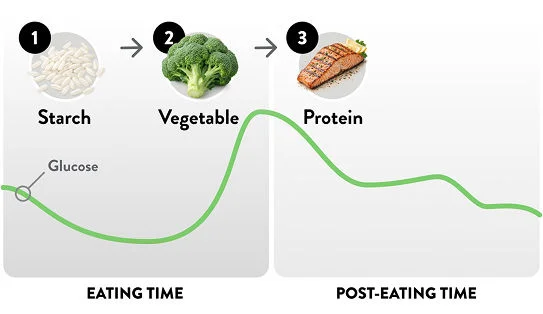
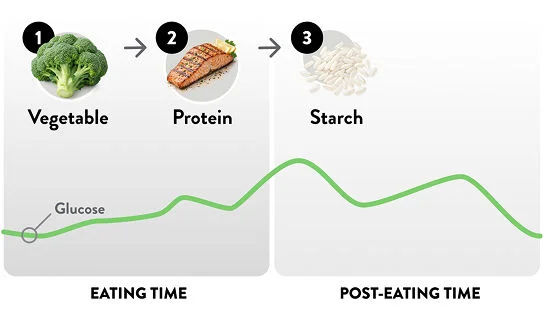
Graph for illustrative purposes only.
Food sequencing isn’t just about time in range. It offers a few potential benefits for managing diabetes.
Feel fuller for longer.
Ever finish a meal or snack and still feel hungry? Starting with fiber-rich vegetables and protein can help you feel full sooner and stay satiated longer1.
Increase your overall fiber intake.
A higher-fiber diet can support time in range, heart health, and digestion19. In one study, people with diabetes who followed food sequencing ended up eating much more fiber than those who didn’t. They also reduced carbs, cholesterol, and salt3.
Slow down and avoid overeating.
By eating one food group at a time, food sequencing may help you eat more slowly overall. Eating too quickly can lead to overeating because it takes about 20 minutes for your stomach to signal your brain that you’re full20.
Make healthy eating easier.
Research suggests that food sequencing is sustainable4. It’s not about strict rules or giving up your favorite foods—it’s just a shift in how you eat the foods on your plate. No matter your culture or cuisine, you will likely be able to apply this method.
Food sequencing is just one tool in your diabetes management toolbox, but it could make a big difference. Start small, observe how your body responds, and take it one day at a time. These little steps can add up to real progress and help you live life with diabetes on your terms.
The right diabetes meal plan not only provides the nutrients your body needs but also helps keep your glucose levels steadier after eating. Over time, an effective diabetes meal plan can support weight management, improve insulin sensitivity13, and even help some individuals slow or reverse the progression of early-stage type 2 diabetes21.
References: 13. Mayo Clinic Staff. “Diabetes Diet: Create Your Healthy‑Eating Plan.” Mayo Clinic, April 19, 2026. Accessed September 8, 2026. https://www.mayoclinic.org/diseases-conditions/diabetes/in-depth/diabetes-diet/art-20044295. 21. Shibib, Lina, et al. “Reversal and Remission of T2DM – An Update for Practitioners.” Vascular Health and Risk Management 18 (2022): 417–43. https://doi.org/10.2147/VHRM.S345810.
Food sequencing should complement, not replace, established dietary strategies like carb counting and portion control19. It’s an additional tool to help stabilize glucose, but it works best alongside a balanced diet, regular physical activity, and your overall diabetes care plan.
Reference: 19. Reynolds, Andrew N., Amy P. Akerman, and Jim Mann. “Dietary Fibre and Whole Grains in Diabetes Management: Systematic Review and Meta-Analyses.” PLOS Medicine 17, no. 3 (2020): e1003053. https://doi.org/10.1371/journal.pmed.1003053.
Food sequencing is about small adjustments, not perfection. To introduce fiber first, consider having a small salad, vegetable soup, or raw vegetable sticks before your main meal. Then, do your best to choose “combination” foods that offer plenty of vegetables and lean protein.
At restaurants, you can still follow food sequencing. Skip the bread basket, or ask the server to deliver it later. Instead, start with a salad, vegetable-based appetizer, or steamed vegetables. Choose a protein-rich main course, like grilled fish, chicken, or tofu. If you eat bread, rice, or pasta, do so at the end of your meal.
Absolutely—apply the same principle to snacks. Start with a handful of veggies like baby carrots or celery10, followed by a protein-rich option like cheese, nuts, or a boiled egg7. If you’re still hungry, finish with a small serving of fruit or whole-grain crackers11.
References: 7. American Diabetes Association. “Protein Food For Diabetes.” Accessed September 9, 2026. https://diabetes.org/food-nutrition/reading-food-labels/protein. 10. American Diabetes Association. “Non-Starchy Vegetables for Blood Glucose Control.” Accessed September 9, 2026. https://diabetes.org/food-nutrition/reading-food-labels/non-starchy-vegetables. 11. American Diabetes Association. “Understanding Carbs.” Accessed September 9, 2026. https://diabetes.org/food-nutrition/understanding-carbs.

Learn more about Libre systems today.

Build diabetes-friendly meals13 with a few steps.
Your guide to creating balanced meals—no complicated rules or counting.

Grab-and-go healthy snacks for busy days.
Easy snack ideas can help you stay prepared with diabetes.

How movement can help manage diabetes stress.
Discover the benefits of adding a few more minutes of movement.
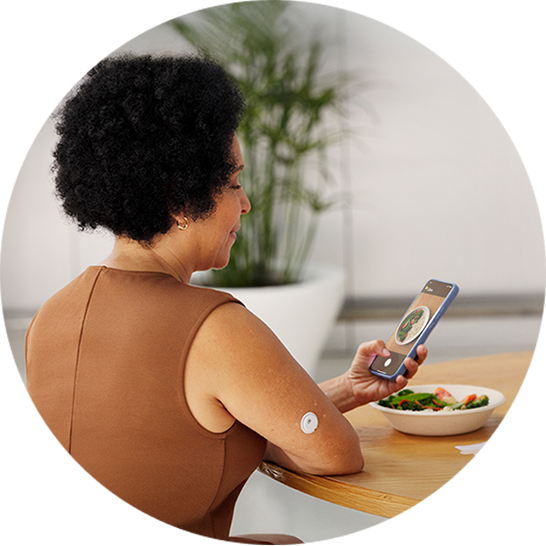
Make in-the-moment food choices.
The FreeStyle Libre 3 Plus sensor, along with Libre Assist‡, can help you predict the impact of food on your glucose§
Snap.
Take a photo of your meal.
Predict.
Libre Assist‡ predicts how your food can impact glucose§.
Know.
Get personalized food suggestions¶ to help lower glucose impact.
Want to try Libre systems and see how it works for yourself? Request a free♢ sensor now.
Share this article:


FreeStyle Libre 3 system is cleared to be used by children 4 years and older with Libre 3 sensor and 2 years and older with Libre 3 Plus sensor.
FreeStyle Libre 2 system is cleared to be used by children 4 years and older with Libre 2 sensor and 2 years and older with Libre 2 Plus sensor.
Medicare and other payor criteria may apply.
* Study was performed with the outside US version of the FreeStyle Libre 14 day system. Data is applicable to FreeStyle Libre 2 and 3 systems, as feature sets are similar as FreeStyle Libre 14 day system, excluding alarms.
† Based on retail sales data for patients’ last-filled prescription, by manufacturer. ADC DME data based on internal reports, Dexcom DME data based on Dexcom earnings reports.
‡ Libre Assist is a feature within Libre app that uses generative artificial intelligence to provide information on how foods could impact your glucose levels. Generative artificial intelligence may not always be accurate, and it should not be used to make treatment decisions.
§ Predicted glucose impact is based on user-provided food data and may differ from actual impact, which depends on sensor readings and factors like activity, stress, medication, and alcohol. For personalized advice, consult your healthcare provider.
# The FreeStyle Libre systems apps are only compatible with certain mobile devices and operating systems. Please check the Support section of our website for more information about device compatibility before using the apps. Use of the FreeStyle Libre systems apps may require registration with LibreView.
¶ Personalized food suggestions are based on food preference information inputted by the user.
References: 1. Kubota, Sodai, et al. “A Review of Recent Findings on Meal Sequence: An Attractive Dietary Approach to Prevention and Management of Type 2 Diabetes.” Nutrients 12 , no. 9 (2020): 2502. https://doi.org/10.3390/nu12092502. 2. Sun, L. Clinical Nutrition. (2019): https://doi.org/10.1016/j.clnu.2019.04.001. 3. Nitta, Ayasa, et al. “Impact of Dietitian-Led Nutrition Therapy of Food Order on 5-Year Glycemic Control in Outpatients with Type 2 Diabetes at a Primary Care Clinic: Retrospective Cohort Study. ” Nutrients 14 , no. 14 (2022): 2865. https://doi.org/10.3390/nu14142865. 4. Shukla, Alpana P., et al. “A Randomized Controlled Pilot Study of the Food Order Behavioral Intervention in Prediabetes.” Nutrients 15, no. 20 (2023): 4452. https://doi.org/10.3390/nu15204452. 5. Mayo Clinic Staff. “Blood Sugar Levels Can Fluctuate for Many Reasons." Mayo Clinic. July 30, 2024. Accessed September 8, 2026. https://www.mayoclinic.org/diseases-conditions/diabetes/expert-answers/glucose-levels/faq-20424316. 6. Centers for Disease Control and Prevention. “Fiber: The Carb That Helps You Manage Diabetes.” January 29, 2025. Accessed September 8, 2026. https://www.cdc.gov/diabetes/healthy-eating/fiber-helps-diabetes.html. 7. American Diabetes Association. “Protein Food for Diabetes.” Accessed September 8, 2026. https://diabetes.org/food-nutrition/reading-food-labels/protein. 8. Papakonstantinou, Emilia, Christina Oikonomou, George Nychas, and George D. Dimitriadis. “Effects of Diet, Lifestyle, Chrononutrition, and Alternative Dietary Interventions on Postprandial Glycemia and Insulin Resistance.” Nutrients 14, no. 4 (2022): 823. https://doi.org/10.3390/nu14040823. 9. Centers for Disease Control and Prevention. “Choosing Healthy Carbs.” Accessed September 8, 2026. https://www.cdc.gov/diabetes/healthy-eating/choosing-healthy-carbs.html. 10. American Diabetes Association. “Non-Starchy Vegetables for Glucose Control.” Accessed September 8, 2026. https://diabetes.org/food-nutrition/reading-food-labels/non-starchy-vegetables. 11. American Diabetes Association. “Understanding Carbs.” Accessed September 8, 2026. https://diabetes.org/food-nutrition/understanding-carbs. 12. Centers for Disease Control and Prevention. “Diabetes Meal Planning.” May 15, 2025. Accessed September 8, 2026. https://www.cdc.gov/diabetes/healthy-eating/diabetes-meal-planning.html. 13. Mayo Clinic Staff. “Diabetes Diet: Create Your Healthy‑Eating Plan.” Mayo Clinic, April 19, 2026. Accessed September 8, 2026. https://www.mayoclinic.org/diseases-conditions/diabetes/in-depth/diabetes-diet/art-20044295. 14. Touhamy, Samir II, et al. “Carbohydrates-Last Food Order Improves Time in Range and Reduces Glycemic Variability.” Diabetes Care 48, no. 2 (2025): e15–e16. https://doi.org/10.2337/dc24-1956. 15. Fokkert, Marion, et al. "Improved Well-Being and Decreased Disease Burden After 1-Year Use of Flash Glucose Monitoring (FLARE-NL4)." BMJ Open Diabetes Research & Care 7, no. 1 (2019): e000809. https://doi.org/10.1136/bmjdrc-2019-000809. 16. American Diabetes Association. Good to Know: “Continuous Glucose Monitoring and Nutrition.” Clinical Diabetes 42, no. 3 (2024): 463. https://doi.org/10.2337/cd24-pe03. 17. Willis, Holly J., Maren S. G. Henderson, Laura J. Zibley, and Meghan M. JaKa. “'Now I Can See It Works!' Perspectives on Using a Nutrition-Focused Approach When Initiating Continuous Glucose Monitoring in People with Type 2 Diabetes: Qualitative Interview Study.” JMIR Diabetes 10 (2025). https://doi.org/10.2196/67636. 18. Merino, Jordi, et al. “Validity of Continuous Glucose Monitoring for Categorizing Glycemic Responses to Diet: Implications for Use in Personalized Nutrition.” The American Journal of Clinical Nutrition 115, no. 6 (2022): 1569–1576. https://doi.org/10.1093/ajcn/nqac026. 19. Reynolds, Andrew N., Amy P. Akerman, and Jim Mann. “Dietary Fibre and Whole Grains in Diabetes Management: Systematic Review and Meta-Analyses.” PLOS Medicine 17, no. 3 (2020): e1003053. https://doi.org/10.1371/journal.pmed.1003053. 20. Gudi, S. K. “Eating Speed and the Risk of Type 2 Diabetes: Explorations Based on Real-World Evidence.” Annals of Pediatric Endocrinology & Metabolism 25, no. 2 (2020): 80–83. https://doi.org/10.6065/apem.2040028.014. 22. ADA Nutrition & Wellness Team. “What Is the Diabetes Plate?” Diabetes Food Hub. American Diabetes Association, January 15, 2025. Accessed September 8, 2026. https://diabetesfoodhub.org/blog/what-diabetes-plate.
The "Yes" link below will take you out of the Abbott Laboratories family of websites. Links which take you out of Abbott Laboratories worldwide web sites are not under the control of Abbott Laboratories, and Abbott Laboratories is not responsible for the contents of any such site or any further links from such site. Abbott Laboratories is providing these links to you only as a convenience, and the inclusion of any link does not imply endorsement of the linked site by Abbott Laboratories.
Do you wish to leave this site?