

Category: Diabetes Education
Category: Diabetes Education

Gibran was playing soccer as a child when he was rushed to the hospital with his first diabetic ketoacidosis (DKA) episode.

“I was going to the restroom every five minutes, feeling nauseous, dehydrated, and my breath was smelling funky,” he recalls. By the time his parents took him to the hospital, he had lost 20 pounds in two weeks and he was minutes away from going into a coma. This is how Gibran, now a youth soccer coach, was first diagnosed with type 1 diabetes (T1D)1.
It’s not unusual for people with diabetes to mistake the symptoms of high ketones or DKA for an illness like the flu2. But the symptoms could be something more serious: DKA is a condition that can impact anyone who relies on insulin3 or SGLT2 (sodium-glucose cotransporter 2) inhibitors4.
For people living with diabetes, DKA is actually the most common emergency related to high glucose levels5,6, though in rare cases, DKA can actually happen without high glucose5,7.
Don’t know much about DKA? You’re not alone*8.
46% of people living with diabetes are unable to name DKA symptoms*8.
If you think you might have DKA, seek medical care right away9.
Keep reading to learn about DKA:
- What is DKA and what causes it?
- What DKA feels like & DKA symptoms
- How to prevent DKA
What is DKA?
DKA happens when the body doesn’t have enough insulin or can’t use insulin properly, which means its cells can’t use glucose for energy9.
- Glucose starts building up in the blood, which is known as high glucose or hyperglycemia10.
- If high glucose goes untreated, the body may start breaking down fat for fuel instead of glucose11.
- This process produces acidic chemicals called ketones11.

A small amount of ketones is normal12, typically under 0.6 mmol/L3. But when too many ketones collect in your bloodstream, they can make your blood dangerously acidic. If not treated quickly, this condition called DKA can become life-threatening11.
Talk to your diabetes care team about what level of ketones you should consider high3.

What causes DKA?
The main cause for DKA is a lack or insufficient amount of insulin in your body. Some situations, such as stress or illness, can cause your body to need more insulin than usual—increasing the risk of DKA13.
Common DKA triggers include13:
- Illness or infections
- Dehydration, as from vomiting
- Severe physical or emotional stress
- Alcohol use
- Certain medications like SGLT2 inhibitors
What DKA feels like—and how to recognize DKA symptoms
DKA may develop slowly at first14, but can escalate to an emergency in just a few hours5,14,15.
Early DKA symptoms include13:
- Excessive thirst
- Intense hunger
- Frequent urination
- Dehydration
More severe DKA symptoms include13:
- Nausea and vomiting
- Abdominal pain
- Fruity-smelling breath, caused by ketones
- Rapid, deep breathing
- Confusion
- Fatigue or weakness
- Loss of consciousness
Diabetes management tips for preventing DKA
If you have diabetes, the following tips can help you avoid a DKA emergency13:
- Talk to your doctor about what to do if you get sick, as illness can trigger DKA.
- Take your insulin or other diabetes medication as your healthcare provider instructs.
- Check your insulin pump for issues or disconnections that could prevent you from receiving insulin.
You’re not alone in your diabetes management. Talk to your healthcare provider13 for help making a plan and learning when to take action.
Diabetic ketoacidosis: Your frequently asked questions
Hyperglycemia happens when you have too much glucose in your bloodstream16. DKA is a serious complication that can happen if high glucose goes untreated11.
A DKA diagnosis typically includes glucose levels of 250 mg/dL or more. But DKA can happen even if your glucose isn’t high. This is called euglycemic DKA, and is rarer than typical DKA5.
Yes, people living with T2D can get DKA, although it’s more common among people living with T1D13.
Yes. DKA can occur in anyone with diabetes—no matter their age or type of diabetes5,15. In some cases, a DKA episode is how T1D is first diagnosed13.
Manage your diabetes with more confidence†17.
Ask your doctor for a FreeStyle Libre 3 Plus sensor prescription today.
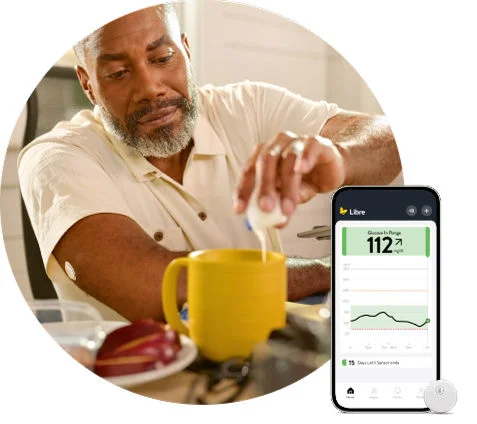
Not actual patient data.
With minute-to-minute readings, you can make more informed choices†17 and lower your A1C†18.
It’s painless19.
The small 15-day sensor is painless to apply and comfortable to wear19.
It’s convenient.
Without fingersticks‡, you have less to manage and worry about. Glucose readings are sent to your smartphone§.
It’s easy to use20.
You can monitor glucose discreetly, comfortably19, and conveniently anytime|| and anywhere¶, just by checking your smartphone§.
CGM = continuous glucose monitor(ing)
More articles you may enjoy
Tips to help ease anxiety from diabetes stress.
Diabetes stress is real, but simple daily habits can help bring more calm.

Meal order matters—start in a glucose-friendly way.
What you eat first and last can affect your glucose.

How movement can help manage diabetes stress.
Discover the benefits of adding a few more minutes of movement.
Share this article:


The FreeStyle Libre 3 system includes the Libre 3 Plus sensor, Libre 3 sensor, Libre 3 app, Libre app, and the Libre 3 reader.
The FreeStyle Libre 2 system includes the Libre 2 Plus sensor, Libre 2 sensor, Libre app, and the Libre 2 reader.
FreeStyle Libre 3 system is cleared to be used by children 4 years and older with Libre 3 sensor and 2 years and older with Libre 3 Plus sensor.
FreeStyle Libre 2 system is cleared to be used by children 4 years and older with Libre 2 sensor and 2 years and older with Libre 2 Plus sensor.
Medicare and other payor criteria may apply.
The views expressed should not be used for medical diagnosis or treatment or as a substitute for professional medical advice. Individual symptoms, situations and circumstances may vary.
* Multinational, multicenter survey of endocrine outpatient clinic patients with average duration of T1D of 22 years (N = 333).
† Study was performed with the outside US version of the FreeStyle Libre 14 day system. Data is applicable to FreeStyle Libre 2 and 3 systems, as feature sets are similar as FreeStyle Libre 14 day system, excluding alarms.
‡ Fingersticks are required if your glucose alarms and readings do not match symptoms or when you see Check Blood Glucose symbol during the first twelve hours.
§ The FreeStyle Libre systems apps are only compatible with certain mobile devices and operating systems. Please check the Support section of our website for more information about device compatibility before using the apps. Use of the FreeStyle Libre systems apps may require registration with LibreView.
|| 60-minute warm-up required when starting the sensor.
¶ Sensor is water-resistant in up to 1 meter (3 feet) of water. Do not immerse longer than 30 minutes.
References: 1. Abbott FreeStyle Libre. User Generated Content. 2. Virdi, Naunihal, Yeesha Poon, Richard Abaniel, and Richard M. Bergenstal. “Prevalence, Cost, and Burden of Diabetic Ketoacidosis.” Diabetes Technology & Therapeutics 25, suppl. 3 (2023): S75–S84. https://doi.org/10.1089/dia.2023.0149. 3. National Health Service (UK). “Diabetic Ketoacidosis.” Accessed September 9, 2026. https://www.nhs.uk/conditions/diabetic-ketoacidosis/. 4. Morace, C., et al. “Ketoacidosis and SGLT2 Inhibitors: A Narrative Review.” Metabolites 14, no. 5, (2024): 264. https://doi.org/10.3390/metabo14050264. 5. Umpierrez, Guillermo E., et al. “Hyperglycemic Crises in Adults With Diabetes: A Consensus Report.” Diabetes Care 47, no. 8 (2024): 1257–1275. https://doi.org/10.2337/dci24-0032. 6. Elzouki, Abdel-Naser, and Mohsen S. Eledrisi. “Management of Diabetic Ketoacidosis in Adults: A Narrative Review.” Saudi Journal of Medicine and Medical Sciences 8, no. 3 (2020): 165-173. https://doi.org/10.4103/sjmms.sjmms_478_19. 7. Lizzo, Jenna M., Amandeep Goyal, and Jasleen Kaur. “Adult Diabetic Ketoacidosis.” In StatPearls [Internet]. Treasure Island, FL: StatPearls Publishing, 2025. Accessed September 9, 2026. https://www.ncbi.nlm.nih.gov/books/NBK560723/. 8. Hepprich, Matthias, et al. “Awareness and Knowledge of Diabetic Ketoacidosis in People with Type 1 Diabetes: A Cross-Sectional, Multicenter Survey.” BMJ Open Diabetes Research & Care 11, no. 6 (2023): e003662. https://doi.org/10.1136/bmjdrc-2023-003662. 9. Mayo Clinic Staff. “Diabetic Ketoacidosis.” Mayo Clinic. Accessed September 9, 2026. https://www.mayoclinic.org/diseases-conditions/diabetic-ketoacidosis/symptoms-causes/syc-20371551. 10. American Diabetes Association. “Hyperglycemia (High Blood Glucose).” Accessed September 9, 2026. https://diabetes.org/living-with-diabetes/treatment-care/hyperglycemia. 11. American Diabetes Association. “DKA: Signs, Symptoms, and Treatment.” Accessed September 9, 2026. https://diabetes.org/living-with-diabetes/dka. 12. Cleveland Clinic. “Ketones in Urine.” Accessed September 9, 2026. https://my.clevelandclinic.org/health/articles/ketones-in-urine. 13. Cleveland Clinic. “Diabetes-Related Ketoacidosis (DKA).” Accessed September 9, 2026. https://my.clevelandclinic.org/health/diseases/21945-diabetic-ketoacidosis-dka. 14. Centers for Disease Control and Prevention. “Diabetic Ketoacidosis.” Accessed September 9, 2026. https://www.cdc.gov/diabetes/about/diabetic-ketoacidosis.html. 15. Nguyen, Kevin T., et al. “Continuous Ketone Monitoring Consensus Report 2021.” Journal of Diabetes Science and Technology 16, no. 3 (2022): 689–715. https://doi.org/10.1177/19322968211042656. 16. Cleveland Clinic. “Hyperglycemia (High Blood Sugar).” Accessed September 9, 2026. https://my.clevelandclinic.org/health/diseases/9815-hyperglycemia-high-blood-sugar. 17. Fokkert, Marion, et al. “Improved Well-Being and Decreased Disease Burden After 1-Year Use of Flash Glucose Monitoring (FLARE-NL4).” BMJ Open Diabetes Research & Care 7, no. 1 (2019): e000809. https://doi.org/10.1136/bmjdrc-2019-000809. 18. Evans, Mark, Zoë Welsh, Sara Ells, and Alexander Seibold. “The Impact of Flash Glucose Monitoring on Glycaemic Control as Measured by HbA1c: A Meta-analysis of Clinical Trials and Real-World Observational Studies.” Diabetes Therapy 11, no. 1 (2020): 83–95. https://doi.org/10.1007/s13300-019-00720-0. 19. Alva, Shridhara, et al. “Accuracy of a 15-day Factory-Calibrated Continuous Glucose Monitoring System With Improved Sensor Design.” Journal of Diabetes Science and Technology (2025). https://doi.org/10.1177/19322968251329364. 20. Haak, Thomas, et al. “Flash Glucose-Sensing Technology as a Replacement for Blood Glucose Monitoring for the Management of Insulin-Treated Type 2 Diabetes: A Multicentre, Open-Label Randomised Controlled Trial.” Diabetes Therapy 8, no. 1 (2017): 55–73. https://doi.org/10.1007/s13300-016-0223-6. 21. Data on file. Abbott Diabetes Care, Inc.
ADC-2660311 v2.0